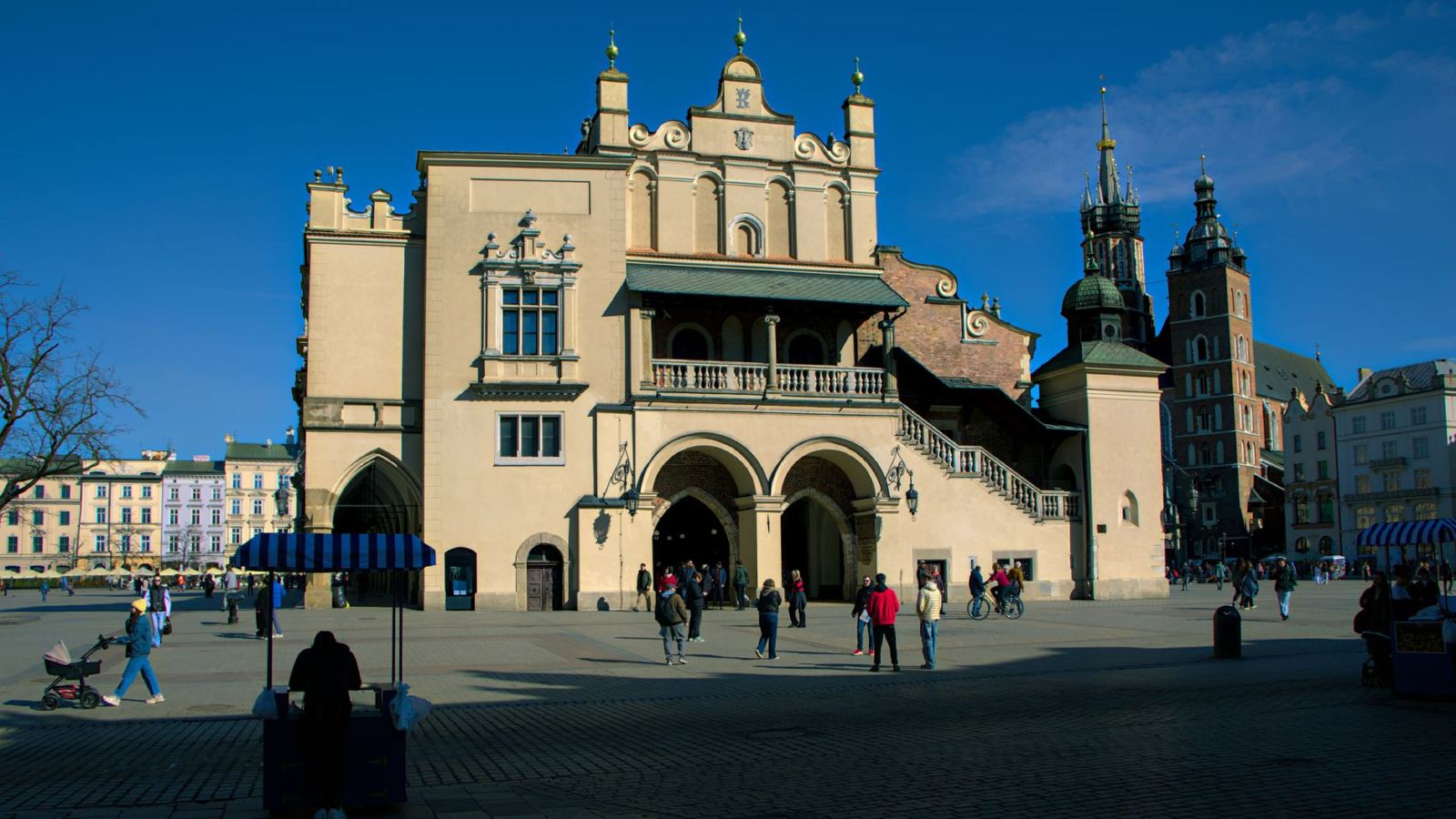
Kraków, the rare Polish city to escape wartime destruction, preserves its medieval fabric whole — and that fabric remains the everyday backdrop of a cheap, lively, student-filled city. The Rynek Główny, Europe's largest medieval square, stages a different scene every hour: pigeons and a trumpet call in the morning, café lights at night.
The city is also a gateway to heavy memory: the Jewish heritage of Kazimierz, Schindler's factory, and Auschwitz an hour away. To visit Kraków is to read Europe's most beautiful and darkest pages in the same volume.
When to Go
May–June and September are ideal: the square's cafés are open and the weather made for walking. July–August is crowded but festive. In December the Rynek's Christmas market ranks among the region's best; Wawel under snow has its own beauty. Winter is cold, but for such an indoor-rich city it's no obstacle — and prices drop.
What to See & Do
On the Rynek Główny, listen for the hejnał — the trumpet call cut off mid-melody — played hourly from St. Mary's tower; inside, the basilica's Veit Stoss altarpiece rewards the visit. Beneath the Sukiennice (Cloth Hall) in the square's centre, the Rynek Underground museum opens the medieval city beneath your feet.
Wawel Hill — cathedral and royal castle — is the heart of Polish history; the dragon legend is completed by the statue on the riverbank. In Kazimierz, the synagogues, the zapiekanka stalls of Plac Nowy and the flea market show a neighbourhood living past and present on the same street. Across the river, the Schindler Factory museum tells the occupation years with devastating craft — book ahead.
Two powerful day trips exist: the Auschwitz-Birkenau memorial (guided tour required, allow more than half a day; heavy but necessary) and the underground cathedrals of the Wieliczka Salt Mine. Don't compress both into one day.
Food & Drink
Polish cooking is hearty and warm: pierogi (dumplings, boiled or pan-fried in butter), żurek (sour rye soup in a bread bowl), bigos and gołąbki are the classics. The 'bar mleczny' (milk bar) — a socialist-era relic of people's canteens — serves home cooking for a few złoty; the experience alone is worth it.
Zapiekanka (the half-baguette street classic with melted cheese) from the round building on Plac Nowy is a midnight tradition. The obwarzanek (a bagel-like ring) is morning business from street carts. Vodka culture has its refinements: try żubrówka with apple juice. Craft beer and third-wave coffee have grown fast on the student city's energy.
Practical Tips
The currency is the złoty (PLN); everything is markedly cheaper than Western Europe, but places 'accepting euros' set the rate against you. Cards work everywhere.
The old town is fully walkable; trams handle the rest. The train from the airport takes 20 minutes. Official Auschwitz slots — free or guided — fill weeks ahead; build your plan around that. Evenings in Kazimierz, nights in the old town; the distances between bars are short but the vodka measures generous. Sunday mornings are quiet; shift museum plans to the afternoon.