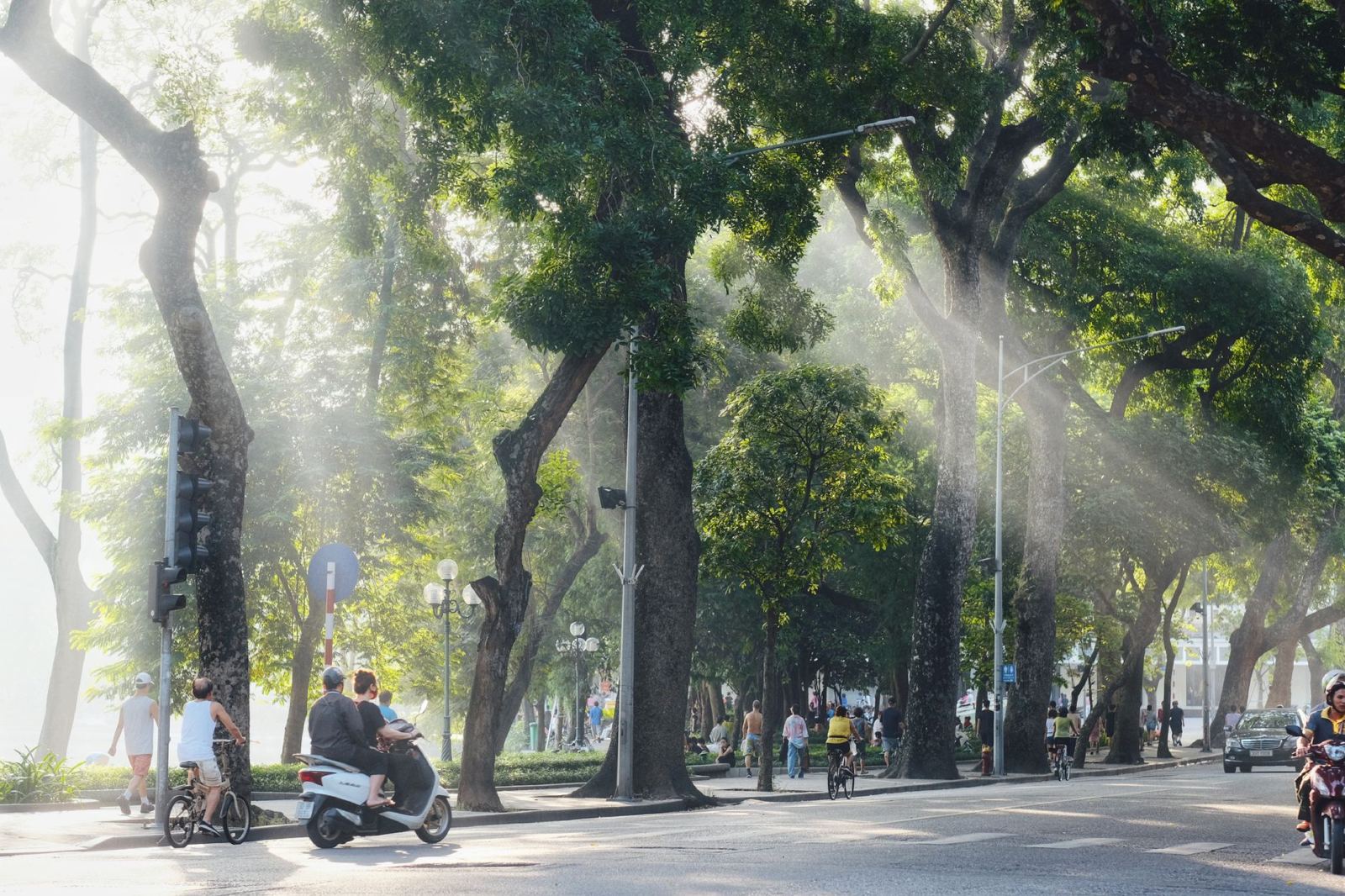
The arriving traveller's first lesson in Hanoi is crossing the street: the motorbike flood never stops — you walk at a steady pace and the flood flows around you. That lesson is really the city in summary: in Hanoi you learn to trust the flow.
The 36 streets of the Old Quarter have been divided among the same craft guilds for centuries: silk street, tin street, paper street... Pavements serve as pho stalls in the morning, barber shops at noon and beer gardens at night. The French colonial legacy — boulevards, the opera house, banh mi — has been kneaded into Vietnam's own fabric, producing one of Asia's most characterful capitals.
When to Go
October–December is prime: dry, clear, 20–28°C. March–April is the second window (spring drizzle and mist possible). January–February is cool and damp; during Tet (Lunar New Year) week the city is both festive and half-shut — shops close for the holidays and transport fills. May–September is oppressively hot with monsoon rain; Halong Bay boats can be cancelled in storms.
What to See & Do
A 6 a.m. walk around Hoan Kiem lake is the city's best introduction: elders at tai chi, badminton nets, the Turtle Tower on its islet. Cross the red Huc bridge to the Ngoc Son temple. On weekends the lakeside closes to traffic and becomes a vast plaza.
Wander the Old Quarter without a plan; add Dong Xuan market and Train Street (check the schedule — the train genuinely passes inches from the houses). The Ho Chi Minh memorial complex (mausoleum open mornings, dress code enforced) and the One Pillar Pagoda take half a day. The Temple of Literature (Van Mieu), with students praying over exam stress in the thousand-year-old university's courtyards, is a living place.
The Museum of Ethnology is the reference point on Vietnam's 54 peoples. The evening water puppet theatre is touristy but genuinely local. For Halong Bay, choose a one-night cruise over a day trip — sunset and morning mist among the limestone towers repay the difference many times over. Alternatives: quieter Lan Ha bay, or Ninh Binh, the 'dry Halong' on land (the Tam Coc rowboat ride).
Food & Drink
Hanoi is the capital of street food capitals, and pho was born here: drink it at 7 a.m., on a plastic stool, shoulder to shoulder with locals. Bun cha (grilled pork with noodles — a lunchtime affair), banh mi and fresh spring rolls (nem cuon) form the core curriculum. Cha ca (turmeric fish, finished in a pan at your table) is the city's classic speciality.
The coffee chapter justifies the trip by itself: ca phe trung (egg coffee — a Hanoi invention), ca phe sua da (iced with condensed milk) and coconut versions, drunk in cafés hidden up apartment staircases. The bia hoi corners (fresh daily-brewed beer, among the world's cheapest) are the late-afternoon social scene. The rule never changes: the busy stall is the fresh stall — and the stall cooking only one dish cooks it best.
Practical Tips
Street-crossing technique: walk at a constant speed, never step back — the motorbikes calculate around you; running or stopping invites the accident. Motorbikes may appear on the pavement too; don't wander in headphones.
The Grab app (moto-taxis included) is the transport standard; in street taxis, insist on the meter. Bargaining is normal in markets, not in restaurants. The currency is the dong; the string of zeros confuses — double-check notes in your first days. Visa rules vary by nationality — check the e-visa system in advance. Don't drink tap water; ice is fine in reputable places. Shoulders and knees covered at the mausoleum and temples. The 'helpful' shoe repairman and the photo-op fruit vendor are the classic small traps — smile and keep walking.